Foreword
I’m a little reluctant to write this article, to be honest. Does the world really need another article on strategy? But it’s so important, and despite the extensive coverage of the topic, most organizations don’t actually have a strategy.
Instead they have a short list of company-wide metrics imposed on them by the board, and a disorganized collection of projects.
All of these tools are trying to do a very specific job: enable everyone in an organization, at all times, to clearly and confidently explain how their current work is part of a strategy to accomplish the mission of the organization. But so often, they completely fail. The projects have no clear connection to those metrics beyond a forgettable slide deck, and the metrics say nothing whatsoever about the company.
So let’s try to disentangle the mess and define a framework. The purpose of the framework is to do the job described above: to give everyone in an organization the tools to describe the value they create for the organization. And we’ll do this job with a combination of
- the Mission,
- the Strategy,
- and the Work
And importantly, we’ll connect them in a way that gets this job done.
Terminology
Terminology in this space is hard. just know that:
- What I call a strategy statement you might call an OKR, initiative, or just “objective”.
- What I call a project you might call a feature, epic/story, or program. (There are important differences between these things, but they won’t get in the way for this.)
The Framework
The Plan is how everything is connected
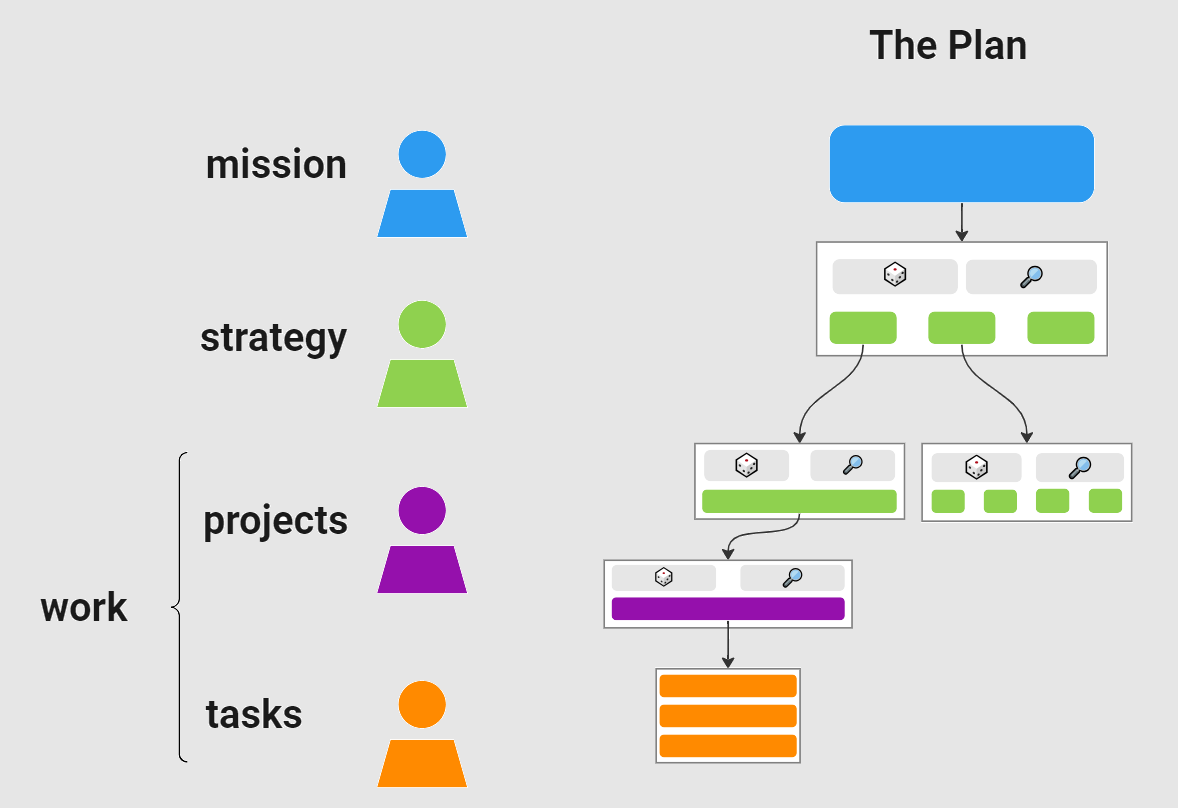
A Plan is the combination of three things: the Mission, the Strategy, and the Work:
- The Mission, which is a single mission statement
- The Strategy, which is a collection of strategy statements (one or more layers)
- The Work, which is a collection of projects and tasks (one or more layers)
The Mission drives the entire Plan
The Mission - a.k.a. the mission statement - is sometimes also called a vision statement or a BHAG (“big hairy audacious goal”). The scale of the Mission should be somewhere between “technically achievable” and “impossible”. It’s the thing that everyone in the company knows by heart, why some of them decided to join in the first place.
The role of the Mission is to set the high-level tone, and to answer the question “why are we here”? It’s the end goal, but it says nothing about how to get there. For most large corporations, the Mission competes with the ever-present “increase value for shareholders” mantra.
Mission statements are unique because no justification is needed for a mission statement.
The Strategy gives the Plan focus
The Strategy illustrates how the Work of the company achieves the Mission. The Strategy is made up of one or more strategy statements*.* Each statement involves a leap of faith, and by definition cannot be inherently true. In that way they can be thought of as hypotheses or bets. Every strategy statement consists of three things:
- The big goal it’s connected to
- A set of prioritized smaller goals
- A clearly articulated argument for why the company believes that achieving the smaller goals will lead to the achievement of the big goal. e.g. “we believe that if this, then that, because…”
The big goal for a strategy statement can be the Mission, or it can connected to one of the smaller goals of a higher level strategy statement.
Each goal needs a person or group that owns it. Any person or group that has more than one goal must clearly prioritize their goals; if they don’t, making the best decisions becomes increasingly arbitrary and impossible.
The first level of strategy statement is the most difficult. It’s almost impossible to optimize through any other process than iteration, and that iteration can be difficult and expensive.
Even then, once the small goals are decided, distilling them down into short statements is extremely challenging, prioritizing them is even harder, and invariably some strategic statements are riskier bets than others, but risky doesn’t mean bad. Still, as much justification as can be presented should be presented, especially at the high level. And that can mean that there’s a LOT of supporting material involved.
The Work is how the Plan gets done
The work is the collection of discrete things you build or do in order to achieve the strategy statements. This is typically something similar to projects and tasks, where a project is a collection of tasks or smaller projects undertaken to do something specific. Shipping a feature, sponsoring an event, giving a talk, acquiring a customer: all of these are projects (in addition to other things).
The transition from the Strategy to the Work
At some point for every organization, the Small Goals aren’t goals anymore, they’re projects or tasks. This is where the strategy stops and the work starts.
- For many organizations, step 2 is not even done once, they just a vision and a collection of projects. Either no strategy exists, or it isn’t communicated to the team.
- For some, a shallow strategy exists: these steps are iterated through once or twice, first breaking down the vision into a small set of measurable objectives (a “North Star metric” or KPIs), and then departments will divvy these up once more and define the projects for their teams.
- For a few organizations, this iterative strategizing into the details of specific areas of focus is done all the way down to each team of ICs. Properly implemented OKRs are a good example of this.
Wherever the transition happens from strategy to planning, that is the last point in the organization where the team has ownership.
Choosing a shallow strategy can be a better decision if the feeling of ownership of a IC teams is low, if they don’t have access to enough information to make informed decisions, if leadership has the same or more knowledge as all of their IC teams, or if the domain that the organization operates in doesn’t evolve quickly.
Choosing a deep strategy is typically a better decision if teams have diverse specializations, if they have strong feelings of ownership of their work, if they have easy access to relevant information within the organization, and if the organization operates in a quickly evolving domain.
It’s not uncommon for companies to want to take on the second option, but if the team isn’t ready for it, asking teams to take on more than they’re interested in can lead to worse performance or confusion. A shallow strategy is better than no strategy at all.